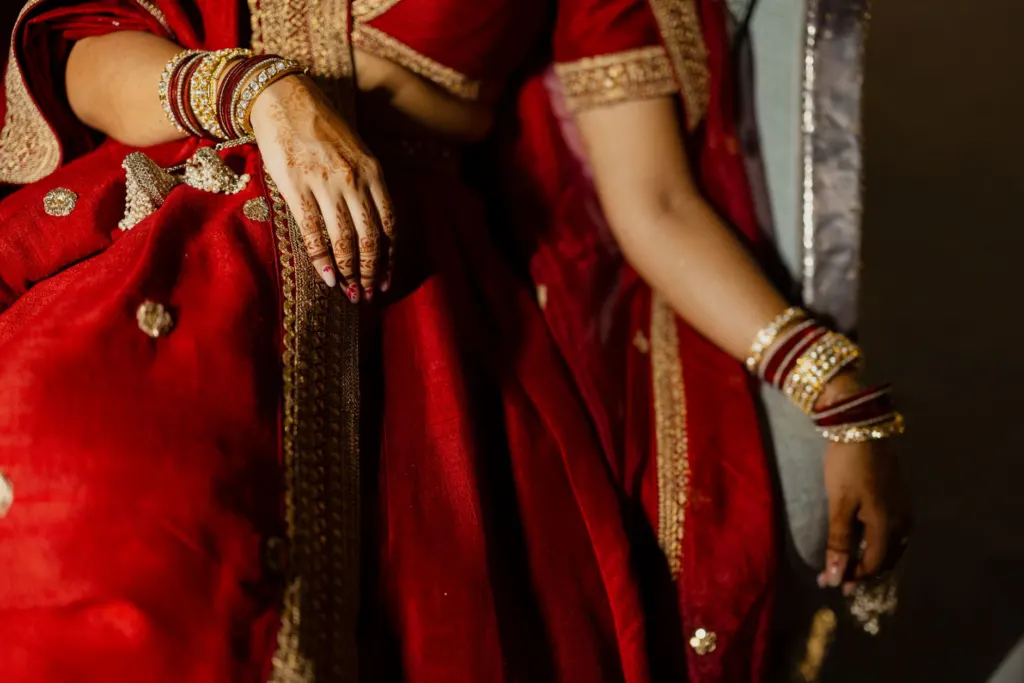
Saree or lehenga? For most wedding guests the lehenga is the easier choice, because it goes on like a skirt and top and is simple to dance in. Choose a saree if you want the classic draped look and have practised the drape, or have someone to help. Both are right for every event at an Indian wedding, so the decision comes down to comfort, budget and the day itself.
What each one is
A saree is not a stitched dress. It is one long, unstitched piece of woven fabric, 4.5 to 9 yards in length (see Wikipedia’s entry on the sari). You wrap it around the waist, gather pleats at the front and take the loose end over one shoulder. It is worn over a fitted blouse and a petticoat. There is no zip or button, because the fabric simply tucks into the petticoat’s waistband.
A lehenga is a three-piece outfit: a long flared skirt, a fitted blouse (choli) and a dupatta, a long scarf. The skirt fastens at the waist like any other skirt, so only the dupatta needs draping.
Saree vs lehenga side by side
| Saree | Lehenga | |
|---|---|---|
| What it is | One unstitched length of fabric, draped | Stitched skirt and blouse, plus a dupatta |
| Getting dressed | Needs practice or a helper | Goes on like a skirt and top |
| Dancing | Manageable if the drape is secure | Easy, and the skirt twirls |
| Sitting on the floor (as at a Sikh ceremony) | Try it at home first | Easier in a light skirt than a heavy one |
| Weight | Light in georgette or organza, heavy in bridal silk | Rises with embroidery and layers under the skirt |
| Fit | No size; only the blouse is fitted | Skirt and blouse must both fit |
| Lending and borrowing | Easy, because it has no size | Harder, because it is fitted to you |
| Guide price | £45 to £410 | £385 to £1,475 |
Guide prices are for the first products listed in each range on Manyavar’s UK site on 22 November 2026.
Comfort and effort
The lehenga wins on ease. You put it on like any skirt and top, and it stays put. Only the dupatta needs managing. Traditionally it goes over one shoulder and tucks into the skirt on the other side, which keeps your hands free.
A saree takes longer, because draping one neatly is a skill. Do a trial run before the day. If you are a guest, ask a friend or a relative of the couple to help. Alternatively, buy a pre-draped saree, which is explained below.
Cost and fit
Fabric and handwork decide the price of both, so the guide prices above are only a snapshot. However, at that shop the lehengas start far higher than the sarees.
The other difference is fit. A saree has no size, so only the blouse needs fitting. As a result, sarees are easy to borrow, lend and buy online. A lehenga has to fit at the waist and in length, and made-to-order pieces can take several weeks. Before you pay, check:
- The saree blouse. Is it stitched, or an unstitched blouse piece that a tailor must make up?
- The petticoat. A saree needs one underneath, so ask whether it is included.
- The lehenga size. Can the shop adjust the waist, length or blouse, and how long will that take?
- Returns. If you order online, the usual 14-day right to change your mind does not cover made-to-measure items, as Citizens Advice explains.
For shops, online ordering and hiring, see where to buy Indian wedding clothes in the UK.
Which suits which event
- Mehndi – a light lehenga, or skip both for a sharara set or salwar kameez.
- Sangeet – lehenga, because you will be dancing. A light one with a flared skirt is the usual pick.
- Ceremony – either. Follow the family’s lead if you are unsure.
- Reception – either, so choose on comfort. A light saree in organza or tissue with some sparkle suits the evening, and so does a sequinned lehenga.
For brides, custom often decides. The lehenga is common bridal wear mostly in North India, while many South Indian brides marry in a heavy silk saree such as a Kanjeevaram. If you are choosing a bridal set, read our guide to the Indian bridal lehenga. For what each event involves, see Indian wedding clothes, event by event.
In-between options if you cannot decide
- Pre-draped saree (also sold as pre-stitched) – the pleats and the shoulder drape are stitched in place. Therefore it goes on like a skirt and closes with a zip or hook.
- Lehenga-style saree – a saree made to look like a lehenga. You tuck and drape it like a saree, but you do not have to form the front pleats.
- Sharara or gharara set – not a skirt at all. Both are loose trousers worn with a tunic and dupatta, and the gharara is gathered at the knee so that it flares out below.
A half saree, or langa voni, is something else again. It is a traditional South Indian dress for girls between puberty and marriage.
If it is your first Indian wedding
Go with the one you will feel relaxed in all day. For most first-time guests that is a lehenga or an anarkali. Whichever you choose, check the colour rules and venue etiquette in our guide to what to wear to an Indian wedding as a guest.