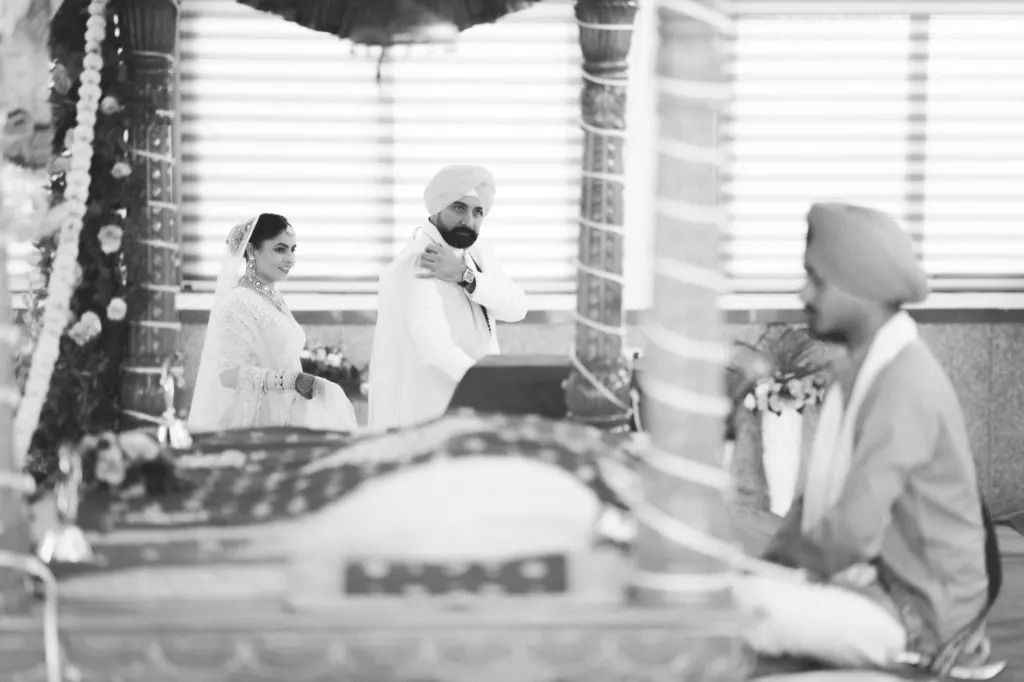
Wondering what to wear to a Sikh wedding? Dress smartly and modestly: cover your shoulders and knees, bring a scarf for your head, and wear shoes that slip off easily. The ceremony, called the Anand Karaj, normally takes place in a gurdwara, the Sikh place of worship. The main rules are therefore about respect for that space. Beyond that, you are free to be colourful and festive.
What to expect on the day
Sikh weddings usually take place in the morning, and the religious ceremony rarely lasts more than a few hours. During it, the couple walk four times around the Guru Granth Sahib, the Sikh holy scripture. Guests sit on the floor, often cross-legged, so plan your outfit around that. In many gurdwaras men sit on one side and women on the other, although mixed seating is fine too.
Afterwards, everyone shares langar, the gurdwara’s free vegetarian meal, and people sit on the floor for that too. A reception in a hall or hotel often follows later in the day. Families differ in how many events they hold, so check the invitation or ask the couple which ones to attend.
Ceremony and reception at a glance
| Ceremony at the gurdwara | Reception | |
|---|---|---|
| Head | Covered, for everyone | No covering needed |
| Shoes | Off before the prayer hall | Stay on, so wear what you like |
| Seating | On the floor | Tables and chairs |
| Coverage | Shoulders and knees covered | More relaxed, but ask if unsure |
| Good choices | Salwar kameez, kurta pyjama, a suit, a long dress | Lehenga, saree, bandhgala, a suit |
If you cannot change between the two, dress for the gurdwara and add jewellery or a brighter dupatta later.
What to wear to a Sikh wedding: gurdwara etiquette
These rules apply to every visitor, whatever their faith. For example, Sri Guru Singh Sabha Southall in west London asks visitors to take off their shoes, wash their hands and cover their heads before they enter the prayer hall.
- Cover your head. This applies to men and women, Sikh or not. Women can use a dupatta, a chunni or a large scarf. Men who do not wear a turban use a rumal, a cloth like a bandana, or a clean, plain handkerchief. Most gurdwaras keep spare head coverings by the entrance, but bringing your own is easier.
- Remove your shoes. Wear shoes that slip off easily, and socks or tights you are happy to show.
- Expect to sit on the floor. Choose an outfit you can sit cross-legged in comfortably. Avoid very short or very tight skirts.
- Dress modestly. Cover your shoulders and knees, and avoid low necklines.
- Leave tobacco and alcohol behind. Gurdwaras do not allow either on the premises, so do not bring them with you.
What women can wear
- Salwar kameez or anarkali – a long tunic with trousers and a dupatta is practical, modest and comfortable on the floor. It is a popular choice for the ceremony.
- Saree – elegant, though you should check that you can sit in it for a long time. Our saree vs lehenga comparison helps you decide.
- Lehenga – a good fit for the reception. It is also fine at the ceremony if the blouse and dupatta give enough coverage.
- Western options – a long dress, or a formal top with trousers, with a shawl or scarf to cover your shoulders and head.
What men can wear
- Kurta pyjama – simple and correct for the ceremony, and easy to sit in.
- A suit – a common choice, especially for guests who are not Sikh. Add a pocket square or a bright tie, and bring a head covering.
- Bandhgala or Nehru jacket – smart for the reception. Our guide to Indian wedding outfits for men has more ideas.
The sherwani is famous as a wedding outfit and the groom may well wear one, so choose something simpler. See our sherwani guide if you are curious about what he may wear.
Do non-Sikh guests need Indian clothes?
No. A suit, or a long dress with a scarf, is fine as long as you follow the gurdwara rules above. If you would like to wear Indian clothes instead, ask the couple or a friend in the family for advice. For the dress codes across a multi-day celebration, read our guide to what to wear to an Indian wedding.
Colours to avoid and colours to wear
Indian brides often wear red as an auspicious colour, so it is kind to leave a full red outfit to the bride. Beyond that, bright and jewel colours are welcome.
Customs on white and black vary between families. If you want to wear either, ask the couple. Otherwise, choose something with plenty of colour alongside it.
Practical tips
- Ask the couple. They can tell you the timings, whether there is a colour theme and what they expect for each event.
- Bring a spare scarf. It covers your head, your shoulders or a cold British morning.
- Allow for a long day. A morning ceremony, a shared meal and a later reception can fill most of a day, so comfort matters.
- Do not worry about being a guest. Gurdwaras are open to everyone, whatever their faith or background, and making an effort is what counts.