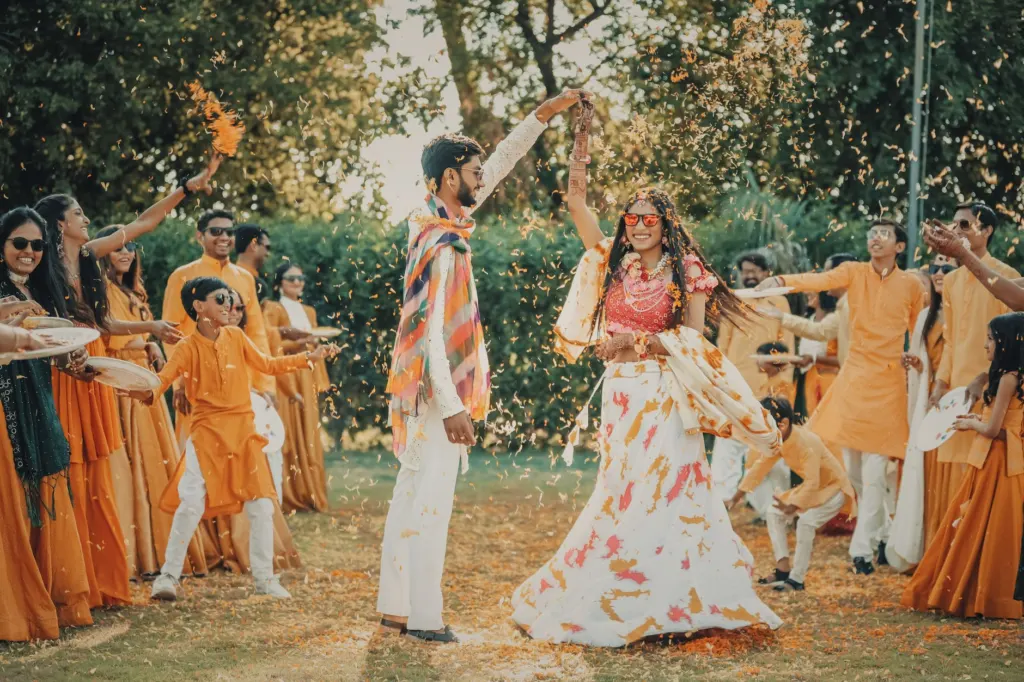
Wondering what to wear to an Indian wedding? Choose something formal and colourful, then keep it modest for the ceremony. For women, that means a saree, a lehenga, a salwar kameez or a long dress. For men, it means a kurta pyjama or a suit. Leave full red to the bride, and avoid plain white too. If the ceremony is in a temple or gurdwara, cover your shoulders and knees.
Can I wear Indian clothes if I am not Indian?
Yes. Wearing Indian clothes is usually taken as a compliment, because it shows you have made an effort to join in. If you would feel more comfortable in Western clothes, that is fine too. A midi or maxi dress, or a suit with a bright tie or pocket square, fits in well.
Colours to avoid
- Red – Indian brides often wear red as an auspicious colour, so leave a full red outfit to her. A touch of red is fine.
- White – the colour mourners wear at a Hindu funeral, so avoid plain white from head to toe. White with plenty of colour or gold is an easier choice.
- Black – views differ between families. Some avoid it at the ceremony, while it is common at evening receptions. Ask the couple if you are unsure.
Almost everything else is welcome. Jewel tones, pinks, greens, blues, yellows and oranges all work, so nobody will think you are overdressed. If the invitation sets a colour theme, follow that instead.
What women can wear
- Lehenga – a long, full skirt with a fitted blouse and a dupatta (a long scarf). It is festive and easy to wear, because nothing needs draping.
- Saree – a length of unstitched fabric draped over a blouse and petticoat. It suits every event. Ask a friend to drape it, or buy a pre-draped one.
- Anarkali or salwar kameez – a tunic over trousers, worn with a dupatta. This is the most comfortable option, and a sensible first Indian outfit. Our anarkali suit guide explains the styles and how to choose one.
Our saree vs lehenga comparison covers comfort, cost and how much help you need to get dressed.
What men can wear
- Kurta pyjama – a loose, collarless tunic with trousers. It is simple, comfortable and correct at every event. Add a sleeveless Nehru jacket to smarten it up.
- Bandhgala – a tailored jacket with a high, closed collar, worn with trousers. It works well for receptions.
- A Western suit – perfectly acceptable, particularly at the reception.
The sherwani is best known as the groom’s outfit. Therefore, leave it and the turban to him and his close family, unless the couple ask otherwise. Our guide to Indian wedding outfits for men compares the options.
At a temple or gurdwara
If the ceremony is in a place of worship, a few rules apply to every guest. A Sikh ceremony normally takes place in a gurdwara, and gurdwaras welcome people of all faiths. Hindu temples set their own rules, so check the venue’s website too. For more on gurdwaras, see what to wear to a Sikh wedding.
- Shoes come off before you enter the prayer hall. Wear a pair that slips off easily, and socks or tights you are happy to show.
- In a gurdwara, everyone covers their head, whatever their faith. For example, the Sri Guru Singh Sabha gurdwara in Southall asks non-Sikhs to use a handkerchief or scarf. Most gurdwaras also keep spare head coverings by the entrance.
- In a gurdwara, guests sit on the floor, often cross-legged. Very tight skirts and short hemlines are awkward here.
- Cover shoulders and knees. A shawl or dupatta solves most problems. Some temples ask for more. For example, London’s Neasden Temple asks for tops that cover the upper arms and navel, so check before you wear a cropped blouse.
What to wear to an Indian wedding, event by event
If your invitation lists several events, match the mood of each one. The table shows the usual pattern, although families differ.
| Event | What it is | Women | Men |
|---|---|---|---|
| Mehndi | The henna party | A bright sharara set, anarkali or midi dress, with loose sleeves | A bright cotton kurta |
| Haldi | Relatives rub turmeric paste on the bride or groom | Washable cotton, often yellow, that can take a stain | A plain cotton kurta |
| Sangeet | An evening of music and dancing | A light lehenga, sharara set or pre-draped saree with sparkle | A kurta with a Nehru jacket, or a bandhgala |
| Ceremony | The wedding itself, sometimes in a temple or gurdwara | A saree, lehenga or salwar kameez, kept modest | A kurta pyjama or a suit |
| Reception | The party, often with dinner and dancing | Your most glamorous saree, lehenga or gown | A bandhgala or a suit |
You do not need a new outfit for every event. Instead, restyle one or two with a different dupatta, jacket or jewellery. Our guide to Indian wedding clothes, event by event also explains what the couple wear.
Practical tips
- Ask the couple. If the invitation gives no dress code, nobody minds the question.
- Plan for a long day. A ceremony, a meal and an evening reception can fill most of a day, so comfortable shoes matter.
- Bring layers. British venues and British weather are not built for bare midriffs in March, so a wrap or jacket helps.
- Borrow or hire. If you will only wear it once, a friend’s wardrobe or a hire service is a sensible route.