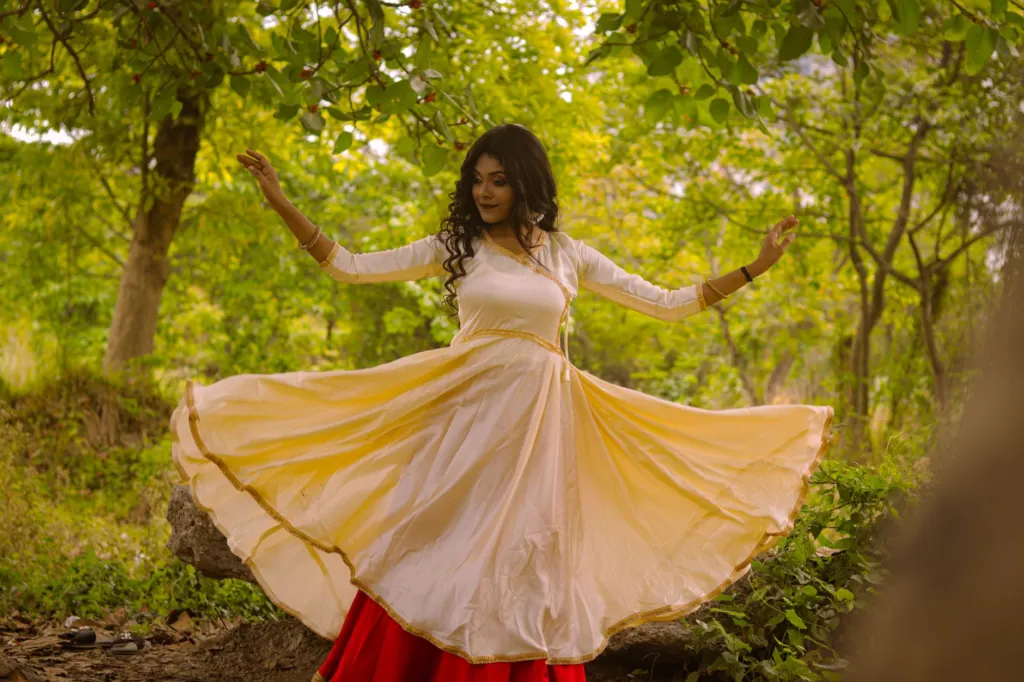
An anarkali suit is a women’s outfit with a long, flared top worn over slim trousers, usually with a matching dupatta (a long scarf). It looks as dressy as a gown, yet there is nothing to drape or pin, so it is one of the easiest Indian outfits to wear to a wedding. Wikipedia’s entry on the anarkali notes that the top can run from knee length to floor length, and that the style takes its name from the character Anarkali in the 1960 film Mughal-e-Azam.
What comes with an anarkali suit
Most are sold as a three-piece set:
- The top – fitted through the bust and waist, then flaring out into a full skirt. Much of the embroidery sits on the bodice and the hem.
- The bottoms – traditionally churidar, slim trousers cut extra long so they gather in folds at the ankle. Some sets come with straight trousers or wide palazzos instead.
- The dupatta – worn over one shoulder, across both, or over the head when the venue calls for it.
Floor-length versions are often sold as anarkali gowns. Read the listing carefully, because some include all three pieces and others do not.
Anarkali styles compared
| Style | What it looks like | Good for | Watch out for |
|---|---|---|---|
| Floor-length | The top reaches the ankle and reads as a gown | Ceremony, reception | Hem length depends on your shoes |
| Knee or calf length | Shorter flare that shows the trousers | Mehndi, haldi, daytime events | Can look casual at an evening reception |
| Jacket or cape style | An open layer worn over the top | Autumn and winter weddings | Warm in a crowded hall |
| Very full or tiered skirt | Many panels, so the skirt swirls as you move | Sangeet and dancing | Heavy, and bulky in a car |
Choosing the fabric for each event
Fabric decides how formal the outfit looks, and also how comfortable you will be after eight hours. As a rough guide:
- Cotton and light silk blends – daytime events. They breathe, so they suit a busy mehndi, and our mehndi outfit ideas cover what else works there.
- Georgette – light and floaty, so it moves well. It is a reliable choice for almost any event.
- Net – sheer and glamorous for evenings. However, it needs a lining, and it can snag on jewellery.
- Silk – the most traditional look for the ceremony itself.
- Velvet – heavy and warm, so it suits winter receptions in the UK.
If you plan to dance, pick a lighter fabric. The sangeet outfit ideas guide explains why this matters on the night.
How to get the fit right
The bodice does most of the work. If it is loose at the bust or waist, the skirt hangs flat instead of flaring. So that is the part to have altered first.
Length comes next. Decide on your shoes before the hem is finished, because a floor-length top cut for flats will trail with heels. Then check the sleeves, which are often left long so a tailor can shorten them.
Many UK shops and online sellers offer three versions: stitched (ready to wear), semi-stitched (partly sewn, needs tailoring) and unstitched (fabric only). Semi-stitched and unstitched suits are cheaper to buy. However, you then need a tailor and a few weeks to spare.
Checklist before you buy an anarkali suit
- Is it stitched, semi-stitched or unstitched?
- Are the trousers and dupatta included, or sold separately?
- Is a lining included, especially for net or sheer fabric?
- Does the top length suit your height and the heels you will wear?
- Can you return it? Items made to your measurements are usually excluded from the standard right to cancel online orders.
- If it ships from abroad, how long will delivery take, and will you pay import VAT or handling fees on arrival?
- Can the seller send a photo in daylight? Studio photos often make colours look brighter.
For the main shopping streets, online options and hire, see where to buy Indian wedding clothes in the UK.
How to wear an anarkali suit to a wedding
- Colour – avoid an all-red outfit, which is traditionally the bride’s, and plain white. Our guide to what to wear to an Indian wedding explains the colour rules.
- Dupatta – pin it to one shoulder if you want your hands free. At a gurdwara, use it to cover your head.
- Shoes – block heels or embroidered flats cope best with long days and dance floors.
- Jewellery – with a high or heavily embroidered neckline, choose statement earrings and skip the necklace.
Because the skirt is full, an anarkali is also comfortable when you sit cross-legged on the floor at a temple or gurdwara. That makes it a sensible choice for a long ceremony.