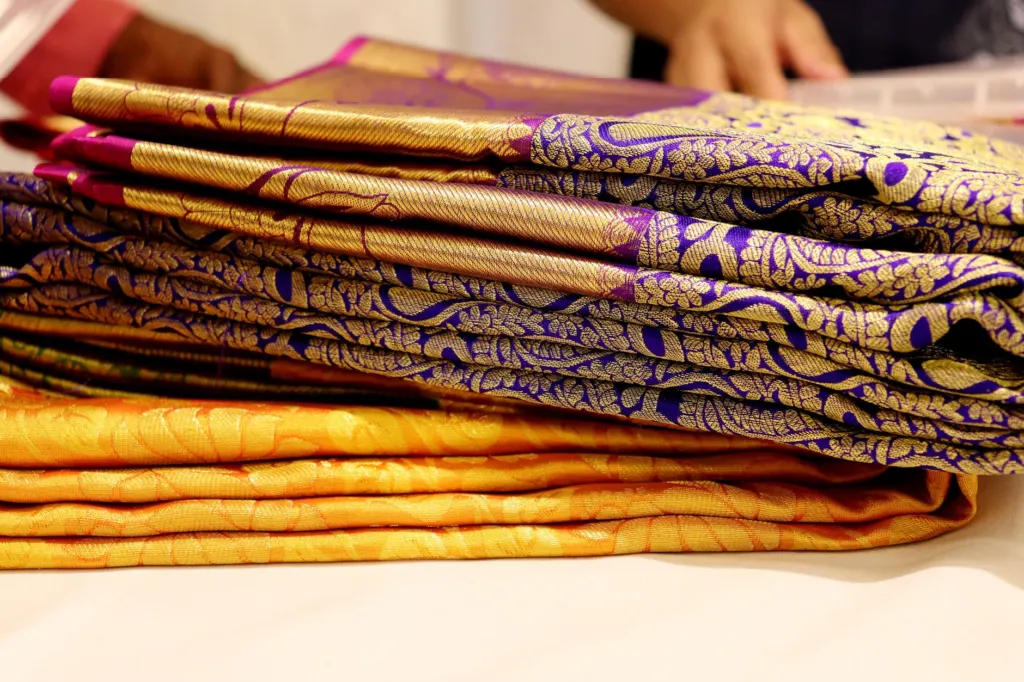
Indian wedding clothes for women are the lehenga, saree, salwar kameez, anarkali and sharara. For men, they are the sherwani, kurta pyjama, bandhgala and dhoti. Which one you wear depends on the event, the region and your role. This guide explains each outfit, then shows who wears what at each event.
Customs change with region, religion and family, and many weddings run over several days. So treat this as a map of the common ground, then check the details with the couple.
The main Indian wedding clothes at a glance
For women
- Lehenga – a long, full skirt worn with a fitted blouse (choli) and a long scarf (dupatta). It is the classic bridal outfit across much of North India, and a favourite for guests too.
- Saree – a single length of unstitched fabric, roughly 4.5 to 9 yards (about 4 to 8 metres) long, draped over a blouse and petticoat (see Wikipedia on the sari). It suits every kind of event, from simple cotton to heavy bridal silk.
- Salwar kameez – a tunic over loose trousers with a dupatta. It is comfortable and easy to move in, so it suits guests well.
- Anarkali – a long, flared, frock-style top worn over fitted trousers. It looks dressy without the effort of draping.
- Sharara and gharara – loose, wide-legged trousers worn with a short tunic and a dupatta. The gharara flares out from the knee, and is a traditional wedding outfit for Muslim women in North India.
For men
- Sherwani – a long, structured coat that buttons down the front and falls below the knee, worn with fitted trousers. It is the best-known outfit for grooms.
- Kurta pyjama – a loose, collarless tunic with straight or fitted trousers. It is the easiest choice for male guests, dressed up with a waistcoat.
- Bandhgala – a tailored jacket with a high closed collar, also called a Jodhpuri suit. It sits comfortably between Indian and Western dress.
- Dhoti – a length of unstitched cloth wrapped around the waist and legs. In South India a similar wrap is called a veshti or mundu.
What the bride wears
Red is the colour most people picture. Brides often wear it because it symbolises auspiciousness. It is also the colour associated with married women, as Wikipedia’s article on the wedding dress notes. A red or deep pink lehenga with gold embroidery is the classic bridal look across much of North India. However, many brides now choose pastels, ivory with colour, or jewel tones. Our bridal lehenga guide covers the shapes, fabrics and colours.
Regional traditions differ a great deal:
- South Indian brides often wear a heavy silk saree woven with gold thread, such as a Kanjeevaram.
- Gujarati brides traditionally wear a red-and-white saree called a panetar. Many also wear a gharchola, a tie-dyed saree that is usually a gift from the mother-in-law.
- Bengali brides wear a headpiece called a mukut with their saree, plus red and white bangles made from shell and coral.
- Punjabi brides wear a chooda, a set of red and white bangles given by the bride’s maternal uncle and aunt.
- Kerala brides may wear a white or off-white saree with a gold border, known as kasavu.
What the groom wears
A North Indian groom typically wears a sherwani in ivory, gold or a colour chosen to complement the bride. He finishes it with a turban (safa or pagri), a stole over one shoulder, and slip-on shoes called mojari or jutti. Some grooms also wear a sehra, a veil of flowers or beads tied to the turban.
In South India the groom often wears a white or cream veshti or mundu, often with a gold border. He adds a shirt or a second cloth over the shoulders. At a Bengali Hindu wedding, the groom wears a white, cone-shaped headpiece called a topor.
Who wears what, event by event
Indian wedding clothes change from one event to the next. The table shows the usual pattern, although every family does it a little differently.
| Event | Bride | Groom | Guests |
|---|---|---|---|
| Mehndi (henna party) | A simple outfit with short sleeves | A light cotton kurta | Bright, playful colours, especially green, yellow and orange |
| Haldi (turmeric ceremony) | Washable cotton with short sleeves | A cotton kurta with pyjama or dhoti | Yellow, and nothing you would be upset to stain |
| Sangeet (music and dancing) | A lighter lehenga with plenty of sparkle | A kurta with a jacket, or a bandhgala | Sequins, bold colours and outfits you can dance in |
| Wedding ceremony | The main bridal outfit, often a red lehenga or a silk saree | A sherwani, or regional dress such as a veshti | Formal and modest, particularly in a temple or gurdwara |
| Reception | Often a second look, such as a saree or gown | A bandhgala or a Western suit | Sarees, gowns, lehengas, suits and bandhgalas |
If you are a guest
Guests are encouraged to dress up, and wearing Indian clothes is usually taken as a compliment, whatever your background. Our guide to what to wear to an Indian wedding as a guest covers the colours to avoid and the rules for religious venues.
If you are stuck choosing between the two most popular outfits, read saree vs lehenga for a comparison of comfort, cost and effort. Our guide to where to buy Indian wedding clothes in the UK covers shopping streets, online shops, ordering from India and hiring.