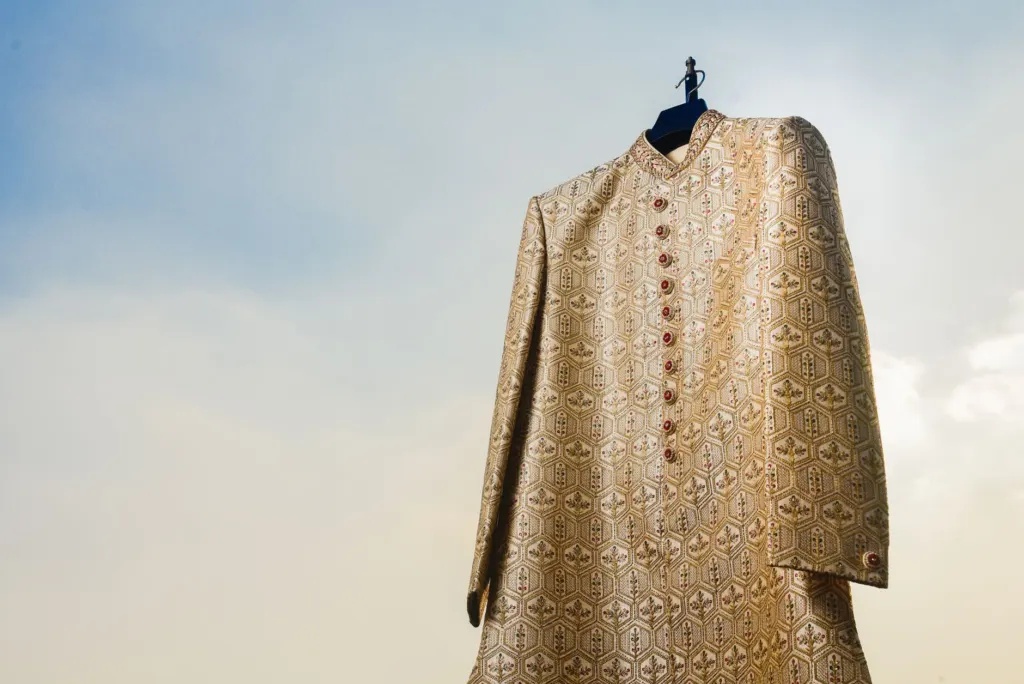
A sherwani for the groom is a long coat that buttons down the front and falls below the knee. In India it is mainly worn with fitted churidar trousers. The Wikipedia article on the sherwani also notes that it is now famous as a wedding outfit. In the UK, expect to pay several hundred pounds, and allow eight to ten weeks if it is made for you.
Choosing a sherwani for the groom: the main styles
Four names come up when grooms shop. However, they overlap, so judge the cut and not the label.
| Style | What it is | Suits |
|---|---|---|
| Classic sherwani | Long coat, buttoned down the front and falling below the knee, often with a stand-up collar | The ceremony and a traditional look |
| Achkan | Knee-length coat that looks similar but is typically less flared at the hips | A slimmer line |
| Indo-western | A fusion outfit that blends Indian style with modern Western cuts | A less traditional look |
| Bandhgala | Short tailored jacket with a closed, high collar, also called a Jodhpuri suit | The reception or an evening event |
Sources disagree on whether the achkan or the sherwani is the longer coat, so try both on.
Fabric and decoration
Sherwanis are sold in silk, art silk, brocade and velvet. Art silk is short for artificial silk: a man-made fibre, often rayon, that looks like silk but costs less. Decoration ranges from plain cloth with fine buttons to embroidery across the whole coat.
Heavy embroidery and velvet add weight and warmth, so think about the season and the venue. A marquee in August and a heated banqueting hall in December ask for different things. Also read the care label, because an embroidered coat may be dry clean only.
Choosing a colour
Cream, beige, champagne and gold are the classic choices. Pastels such as peach and pale pink suit a daytime wedding, while maroon, wine and deep green look rich in the evening.
Coordinate with the bride without matching her exactly. For example, pick up one colour from her outfit in your stole, turban or embroidery. So ask what she is wearing before you shop. For background on bridal colours, see our bridal lehenga guide.
What is worn with a sherwani
- Kurta – the long collarless shirt that usually goes under the coat.
- Trousers – churidar, which fit closely and gather in folds at the ankle, or straight-cut trousers.
- Turban – called a safa or pagri. It can be tied on the day by someone who knows how, or bought ready-made.
- Sehra – a veil of flowers or beads tied to the turban. Traditionally it goes on just before the groom leaves for the bride’s house.
- Kalgi – an ornament pinned to the turban.
- Stole – a long scarf, also called a dupatta, draped over one shoulder or around the neck.
- Mala – strands of pearls or beads worn as a necklace.
- Shoes – embroidered slip-ons called mojari or jutti. Traditional pairs have no left or right shoe and take the shape of the foot over time, so wear them at home first.
In some communities, for example Rajput families, the groom also carries a ceremonial sword in the wedding procession. Your family will tell you if this applies.
Getting the fit right
- The shoulders matter most. The seam should sit at the edge of your shoulder, with no pulling across the back.
- You should be able to raise your arms and sit cross-legged. A Sikh ceremony in a gurdwara, for example, is conducted seated on the floor.
- Sleeves should end at the wrist bone, showing a little of the kurta cuff if you like.
- Allow time for at least one round of alterations, and try the full outfit, including shoes and turban, before the day.
What a sherwani costs in the UK
Prices depend on the fabric and the amount of handwork. As a guide, these were the lowest and highest prices on the first page of each range at Manyavar’s UK store on 22 November 2026:
- Sherwanis: £525 to £840
- Indo-western sets: £295 to £615
- Jodhpuri suits: £320 to £570
Check what a set includes before you compare prices. For example, one £775 set there listed a sherwani, a dupatta and trousers. However, the matching safa (£135) and mala (£35) were sold separately. Other shops and tailors set their own prices, so ask for a written quote.
When to order
Lead times differ between shops. As one UK example, Hassan Shafiq Menswear in Bradford gives this timetable:
- Six to nine months before: start looking.
- Made to measure: allow eight to ten weeks from the first consultation to collection.
- Ready to wear: allow two to four weeks.
- Seven to ten days before: have the final adjustment made.
So ask your own shop for its dates and get them in writing.
Buying or hiring
A sherwani for the groom is often worn once, so it is worth asking whether a shop hires as well as sells. If you hire, check what the fee covers, including cleaning, alterations and the deposit. Buying makes sense if you want a particular design or expect to wear it again at family weddings. Our guide to where to buy Indian wedding clothes in the UK covers both routes.
Not the groom? Our guide for male guests explains what to wear without upstaging him.